
Top 5 Free Online Courses That Can Get You a Job in 2026
The platforms employers in India actually recognize, and how to pick the right one for your goal
A free certificate means nothing if you never finish the course — and most people don't. Coursera's own completion data puts free-course finish rates in the single digits. The five platforms below are worth finishing because employers recognize them, not because they're free.
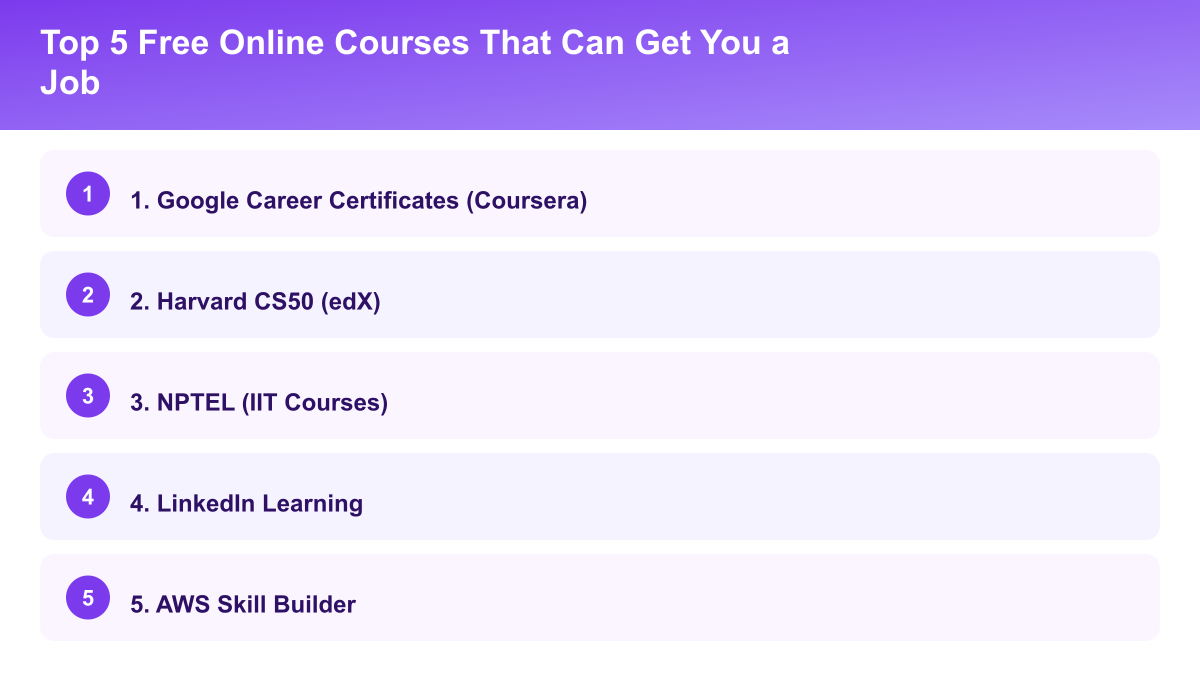
1. Google Career Certificates (Coursera)
Free certificates in Data Analytics, IT Support, UX Design, Project Management, and Cybersecurity, recognized by 150+ employers including TCS, Infosys, and Wipro.
- Time commitment: 3-6 months at 5-10 hours/week
- What you learn: Job-specific tools and workflows (SQL, Tableau, Jira depending on track), not just theory
- How to get it free: Apply for financial aid on Coursera — approved in about 15 days, covers the certificate fee completely
2. Harvard CS50 (edX)
The most-enrolled computer science course in the world. Covers C, Python, SQL, web development, and AI fundamentals.
- Time commitment: 10-20 hours/week for 10-12 weeks
- Cost: Free to audit; the verified certificate costs $149 if you want it on LinkedIn
- Who it's for: Anyone starting software development from zero — it's demanding but the problem sets are what build skill
3. NPTEL (IIT Courses)
Government of India backed, taught by IIT and IISc faculty. Covers engineering, management, and data science.
- Time commitment: 8-12 weeks per course, 3-4 hours/week
- Cost: Course is free; the proctored exam fee is around ₹1,000
- Where it's recognized: PSUs and many MNCs value NPTEL certificates for engineering roles — this one carries more weight in government/PSU hiring than the others on this list
4. LinkedIn Learning
Over 21,000 courses on tech, business, and creative skills. Completed courses show directly on your LinkedIn profile, visible to recruiters searching your skills.
- Time commitment: Most courses are 1-4 hours — built for stacking several quickly
- Cost: First month free with a new account
- Strategy: Pick 4-6 short, specific courses (not broad ones) and finish all of them within the free month — the value is in the visible certificates, not just watching videos
5. AWS Skill Builder
Amazon's official cloud training platform. Free tier includes 500+ courses on AWS services.
- Time commitment: Self-paced; the Cloud Practitioner track takes most people 4-6 weeks
- Cost: Core training is free; the certification exam costs around $100
- Why it matters: AWS-certified roles in India commonly pay ₹8-25 LPA depending on experience, and the free tier is enough on its own to prepare for the entry-level Cloud Practitioner exam
How to Finish One (Most People Don't)
- Pick one, not three — starting multiple free courses at once is the single biggest reason people finish none of them
- Block real calendar time — "whenever I have time" rarely produces enough hours; treat it like a scheduled commitment
- Build something while learning — a small project alongside the course material is what sticks, and gives you something to show in interviews beyond the certificate itself
- Finish before starting the next one — a stack of half-finished courses looks worse on a resume than one completed certificate
Which One to Start With
| Your Goal | Start With |
|---|---|
| Job in 3 months | Google Career Certificate |
| Become a developer | Harvard CS50 |
| Government/PSU eligibility | NPTEL |
| Already working, want a promotion | LinkedIn Learning |
| Highest salary ceiling in tech | AWS Skill Builder |
A Mistake Worth Avoiding
I signed up for four different free courses in the same month once, convinced I'd power through all of them. I finished zero. The platforms above work because the material is good, not because starting a course guarantees you'll finish it. That part is still entirely on you, and it's worth taking seriously before you enroll in a second one.
What Recruiters Actually Look For on a Certificate
A completed certificate on a resume gets a second look mainly when it's paired with something concrete — a project, a portfolio piece, an actual number you achieved because of what you learned. The certificate alone opens the door for maybe ten seconds of extra attention. What you built with it is what gets you the interview.
What Financial Aid Applications Ask For
Coursera's financial aid form asks a few short questions about your income situation and why you want the course. It's not an extensive application, and it doesn't require documentation like pay stubs for most requests. Being specific and honest in the short answer fields, instead of vague, seems to get approved faster based on what I've seen from people who've gone through it — though Coursera doesn't publish exact approval criteria.
Stacking Certificates Without Diluting Any of Them
If your goal is really to build a body of proof rather than just one credential, sequencing matters. Finish a broad foundational certificate first, a Google Career Certificate or NPTEL course, then follow it with a narrower, more specific one that builds directly on it. Two related certificates finished in sequence read as a deliberate skill path on a resume; four unrelated ones finished in a rush read as certificate collecting, and recruiters can tell the difference.
What to Do If a Course Turns Out to Be the Wrong Fit
Discovering three weeks in that a course's pace or format doesn't work for you isn't a reason to force through it out of guilt, switching to a better-fit platform on the same topic costs less time overall than grinding through material that isn't sticking, and it's a completely different decision from the earlier advice about not starting several courses in parallel. Recognizing a bad fit and recognizing a lack of discipline are two different diagnoses, and mixing them up leads to either quitting too early or grinding through something that was never going to work for how you personally learn, regardless of how well it works for everyone else.
Finish One Before You Start Another
A ₹0 course from the right platform really can open doors a ₹5 lakh degree from the wrong college can't — but only the finished ones count. Pick one from the table above based on what you're trying to get hired for, and hold off on bookmarking the next five until this one's done.
Frequently Asked Questions
Recommended Products & Links
Was this article helpful?
Written by
Muthu
I'm Muthu, a software engineer based in India who writes about technology, career growth, and personal finance on the side. I started Techpulzo because most content in these spaces online is either too shallow to be useful or too jargon-heavy to actually help you decide anything — so every article here starts from a real question I'd want answered myself, and tries to show the actual numbers and trade-offs instead of surface-level advice.
Comments
No comments yet. Be the first to share your thoughts!
Related Posts
Complete Guide to Getting a Software Job in India Without a Degree
No CS degree? No problem. This complete guide shows exactly how to land a software job in India using free courses, projects, and the right strategy.
How to Write a Resume That Gets Shortlisted
Before-and-after examples of turning weak bullet points into ones recruiters stop on
Recruiters scan a resume for about six seconds. Before-and-after examples of weak vs. strong bullet points, the structure that gets read, and the mistakes that get resumes rejected instantly.
How to Prepare for a Technical Interview: A Step-by-Step Guide for Freshers
A four-week plan for what to practice, in what order, and how to actually answer under pressure
A structured four-week plan for technical interview prep, plus the non-technical habits — going silent while thinking, not asking clarifying questions — that quietly cost freshers offers.

Is an MBA Worth It in India in 2026 — The Real Math
The break-even calculation that matters more than the generic yes-or-no answer
"Is an MBA worth it" is really three separate questions: is this specific college's placement data strong, does the switch require the credential, and can you afford the real cost. Here's how to run the numbers.