Complete Guide to Getting a Software Job in India Without a Degree
I work as a Java developer, and a fair number of people on my own team never finished a CS degree. In India, lakhs of people still believe a computer science degree is the only path to a software job. That belief is wrong. Here is the complete guide to getting hired as a software developer without one.
Does a Degree Matter in 2026
For product companies (Google, Microsoft, Flipkart, Swiggy), they look at skills and problem-solving ability — degree is secondary. For service companies (TCS, Infosys, Wipro, Cognizant), they prefer degrees but hire based on aptitude tests too. For startups, skills completely outweigh degrees. The truth: a strong GitHub portfolio and real projects will get you more interviews than a degree from a tier-3 college.
Step 1 — Choose Your Stack
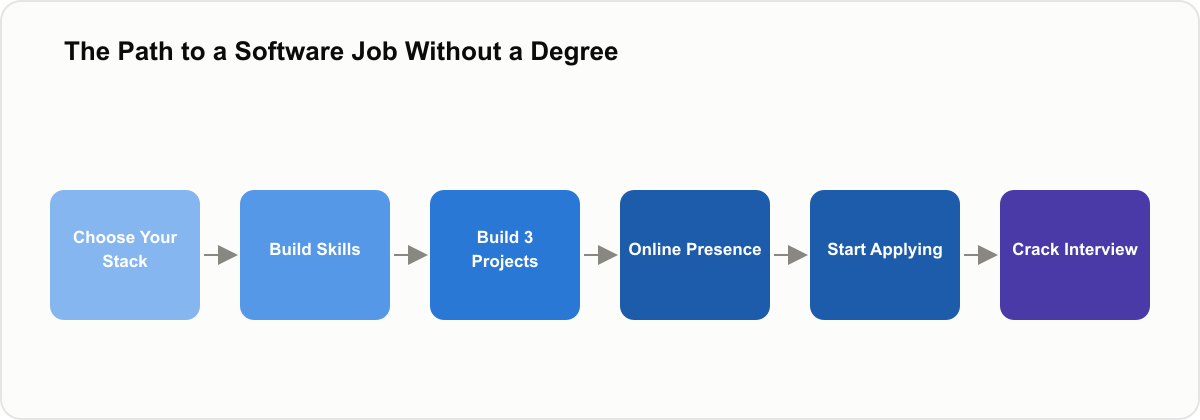
Do not try to learn everything — pick one and go deep.
Option A: Frontend Development
- HTML, CSS, JavaScript, React
- Time to job-ready: 4-6 months
- Salary range: ₹4-12 LPA
Option B: Backend Development
- Python/Java + SQL + APIs
- Time to job-ready: 5-7 months
- Salary range: ₹5-15 LPA
Option C: Full Stack Development
- Frontend + Backend combined
- Time to job-ready: 8-12 months
- Salary range: ₹6-18 LPA
Option D: Data Science
- Python + pandas + ML basics
- Time to job-ready: 6-9 months
- Salary range: ₹5-14 LPA
Step 2 — Build Your Skills
Free resources that are good enough to get hired:
- For web development: The Odin Project + freeCodeCamp
- For Python/backend: CS50P + official Python docs
- For data science: Kaggle Learn (completely free)
- For full stack: Full Stack Open by University of Helsinki (free)
Spend 2-3 hours daily. Consistency beats intensity.
Step 3 — Build 3 Projects
This is the step I'd push hardest on if you only had time for one. I've sat in on interviews where a candidate's resume looked thin on paper, but their GitHub carried the whole conversation. Your projects should:
- Solve a real problem
- Be on GitHub with clear README
- Have a live demo link (use Vercel or Netlify — both free)
Project ideas for beginners: an expense tracker with charts, a weather app with real API data, a job application tracker, a recipe finder app, or a URL shortener.
Step 4 — Build Your Online Presence
LinkedIn profile:
- Professional photo
- Strong headline: "Frontend Developer | React | JavaScript"
- List all projects with GitHub links
- Get 3-5 recommendations from connections
GitHub profile:
- Pin your 3 best projects
- Write clear README files with screenshots
- Contribute to open source (even small fixes count)
Step 5 — Start Applying
Where to apply:
- LinkedIn Jobs — filter by "Entry Level"
- Internshala — great for first internships
- Naukri.com — good for service companies
- Angellist/Wellfound — best for startups
- Company career pages — apply directly
Apply to 20-30 jobs per week. Expect a 5-10% callback rate.
Step 6 — Crack the Interview
Technical interviews test data structures and algorithms (LeetCode Easy/Medium), your project knowledge, be ready to explain every line, and basic system design for senior roles. Non-technical interviews test communication skills, problem-solving approach, and cultural fit. Prepare by solving 50 LeetCode Easy problems before interviews.
Salary Expectations
Fresher (0-1 year experience):
- Startup: ₹3-6 LPA
- Mid-size company: ₹4-8 LPA
- MNC: ₹5-10 LPA
With 2 years experience:
- Startup: ₹8-15 LPA
- MNC: ₹10-20 LPA
Real Timeline
- Month 1-3: Learn the basics of your chosen stack
- Month 4-6: Build 3 projects and put them on GitHub
- Month 7: Start applying and prepare for interviews
- Month 8: Get your first offer
Eight months — that is the honest timeline for a dedicated person.
Dealing With the Degree Question in Interviews
It will come up, directly or indirectly, and dodging it reads worse than answering it head-on. A short, confident answer — "I focused on building real projects and practical skills instead of a formal degree, and here's what I've built" — followed immediately by a concrete example, closes the topic faster than getting defensive about it. Interviewers who care only about the degree usually aren't the ones who got you the interview in the first place; the resume or referral already got past that filter.
Certifications: Useful, But Not a Replacement for Projects
Certificates from Coursera, freeCodeCamp, or AWS/Google Cloud can strengthen a resume, particularly for cloud or data roles where they signal specific tool familiarity. They don't substitute for demonstrable projects, though — a certificate proves you completed a course; a working project proves you can build something. Treat certifications as a supplement to the project-and-portfolio approach, not an alternative to it.
Open Source Contributions as a Credibility Shortcut
A merged pull request on a real open source project, even a small documentation fix or a minor bug patch, carries more weight than it might seem — it demonstrates you can read unfamiliar code, follow a project's contribution process, and get changes accepted by other developers. Start with "good first issue" labels on GitHub repositories in your chosen stack; these are tagged as approachable for newcomers.
Common Reasons the First Few Months of Applying Feel Discouraging
- Applying too broadly before skills are ready — rushing to apply after two months of tutorials, before any real project exists, produces a high rejection rate that has nothing to do with the "no degree" factor and everything to do with the resume itself not being ready yet.
- A portfolio that looks like tutorial output — recruiters and hiring engineers recognize the common "to-do list app" and "clone of X" projects instantly; a project solving a problem specific to your own life or interests stands out more than a generic tutorial clone.
- No feedback loop — applying into a void with no idea why applications aren't converting. Ask anyone who does interview you, even a rejection, for one piece of specific feedback — most people will give it if asked directly and politely.
A Few Honest Answers
You don't need a high-spec laptop to start. Anything from the last five or six years with 8GB of RAM handles web development, backend work, and most beginner data science just fine. Put your money into time and courses, not hardware, until you're hitting a real performance wall. And no, 25, 30, or older isn't too late. Career switchers in their late twenties and thirties land developer roles all the time, because companies hiring for skill over pedigree tend to care more about what you can build today than when you started building it. One more thing worth knowing: interviewers can usually tell within a couple of follow-up questions whether a skill on your resume is real or just copied from a job posting. "Walk me through the last bug you fixed in that" separates the two fast, so only list what you can defend when someone pushes back.
Final Advice
Stop waiting for the perfect course or the perfect time. Start learning today. Build something bad, then build something better. I still remember how rough my own first project looked, and every senior developer you admire started exactly where you are now.
Frequently Asked Questions
Was this article helpful?
Written by
Muthu
I'm Muthu, a software engineer based in India who writes about technology, career growth, and personal finance on the side. I started Techpulzo because most content in these spaces online is either too shallow to be useful or too jargon-heavy to actually help you decide anything — so every article here starts from a real question I'd want answered myself, and tries to show the actual numbers and trade-offs instead of surface-level advice.
Comments
No comments yet. Be the first to share your thoughts!
Related Posts
How to Write a Resume That Gets Shortlisted
Before-and-after examples of turning weak bullet points into ones recruiters stop on
Recruiters scan a resume for about six seconds. Before-and-after examples of weak vs. strong bullet points, the structure that gets read, and the mistakes that get resumes rejected instantly.
How to Prepare for a Technical Interview: A Step-by-Step Guide for Freshers
A four-week plan for what to practice, in what order, and how to actually answer under pressure
A structured four-week plan for technical interview prep, plus the non-technical habits — going silent while thinking, not asking clarifying questions — that quietly cost freshers offers.

Is an MBA Worth It in India in 2026 — The Real Math
The break-even calculation that matters more than the generic yes-or-no answer
"Is an MBA worth it" is really three separate questions: is this specific college's placement data strong, does the switch require the credential, and can you afford the real cost. Here's how to run the numbers.

How to Negotiate Your Salary in India — What Works
A real script, the research to do first, and the mistakes that cost people money
Most people never counter a salary offer at all. A grounded ask, backed by market research, rarely costs you the offer — here's the actual script and the research to do before you send it.