Advertisement
How to Prepare for a Technical Interview: A Step-by-Step Guide for Freshers
A four-week plan for what to practice, in what order, and how to actually answer under pressure
A fresher who solves a problem in silence and gets it right often scores worse than one who talks through a partially-correct approach. Technical interviews are testing whether you can think out loud through something unfamiliar, not whether you've memorized the answer key. Prepare for that.
Week 1 — Fundamentals
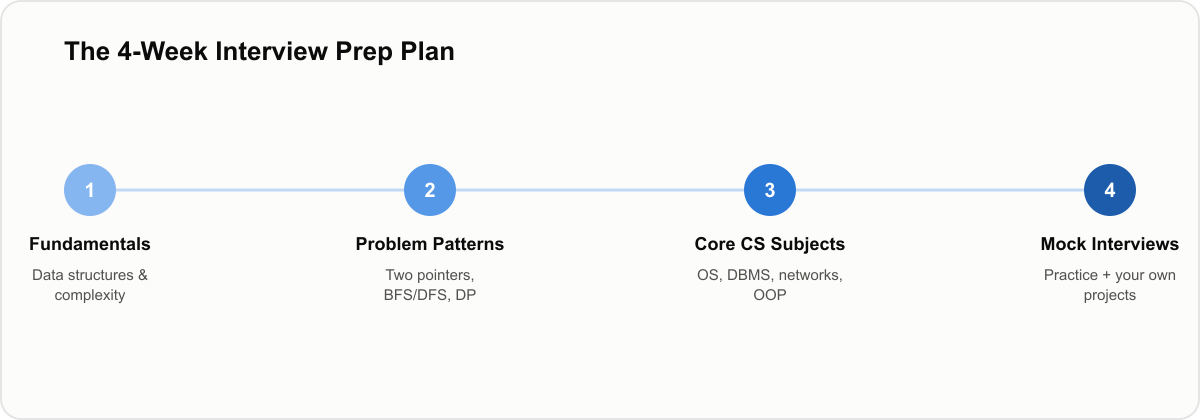
- Data structures: arrays, strings, linked lists, stacks, queues, hash maps
- Time and space complexity — be able to explain Big O for anything you write, not just recite it
- Pick one language and get fluent in its standard library (sorting, string methods, common built-ins)
Week 2 — Problem Patterns, Not Random Problems
Instead of grinding problems at random, learn the recurring patterns: two pointers, sliding window, binary search, BFS/DFS on trees and graphs, basic dynamic programming. Most interview problems are a variation of one of these — recognizing which pattern applies is the real skill.
Week 3 — Core CS Subjects
- Operating systems: processes vs threads, deadlocks, memory management basics
- DBMS: normalization, indexes, joins, ACID properties, basic SQL
- Networks: OSI basics, TCP vs UDP, what happens when you type a URL and hit enter
- OOP: encapsulation, inheritance, polymorphism, with examples you can explain, not just define
Week 4 — Mock Interviews and Your Own Projects
Run 3-5 mock interviews with a friend, senior, or online platform before the real thing. Prepare to discuss 1-2 of your own projects in depth — being unable to explain your own resume in detail is one of the fastest ways freshers lose credibility.
The Six Steps of Actually Answering a Coding Question
- Repeat the problem back in your own words to confirm you understood it
- Ask about edge cases and constraints before writing any code
- Say your approach out loud before coding it, so the interviewer can redirect you early if needed
- Write clean code, narrating as you go
- Test your solution against edge cases yourself before calling it done
- State the time and space complexity of your final solution
What Costs Freshers Offers That Has Nothing to Do With Coding
Going silent while thinking
Interviewers can't evaluate a thought process they can't hear.
Skipping clarifying questions
Jumping straight into code without confirming input format or edge cases reads as impulsive, not confident.
Arguing with a hint
A nudge from the interviewer is usually them trying to help you succeed, not a challenge to defend your original approach.
Having no questions at the end
"Any questions for us?" is part of the evaluation. Prepare two or three genuine ones about the team or tech stack.
Common Questions
The Real Test
Four focused weeks — fundamentals, patterns, core CS, and mock practice — will put you ahead of most freshers grinding problems without a plan, because structured thinking and clear communication are worth more than raw memorization.
Frequently Asked Questions
Advertisement
Was this article helpful?
Advertisement
Comments
No comments yet. Be the first to share your thoughts!
Related Posts

Top 5 Free Online Courses That Can Get You a Job in 2026
The platforms employers in India actually recognize, and how to pick the right one for your goal
Five free platforms with certificates employers actually respect — what each one takes to finish, what it's worth, and how to pick the right one for your specific goal.
Complete Guide to Getting a Software Job in India Without a Degree
No CS degree? No problem. This complete guide shows exactly how to land a software job in India using free courses, projects, and the right strategy.
How to Write a Resume That Actually Gets Shortlisted
Before-and-after examples of turning weak bullet points into ones recruiters stop on
Recruiters scan a resume for about six seconds. Before-and-after examples of weak vs. strong bullet points, the structure that actually gets read, and the mistakes that get resumes rejected instantly.