Buy Now Pay Later in India: The Costs Hidden in the Fine Print
The interest really is zero if you pay on time — the actual cost hides in flat late fees and credit bureau reporting instead.
LazyPay, Simpl, Amazon Pay Later, Flipkart Pay Later — every one of them leads with the same promise: zero interest. For someone who pays on time, that promise holds exactly as advertised. What rarely gets explained anywhere in the checkout flow is what happens the moment you don't pay on time, and why that shift costs more, proportionally, than a missed credit card payment usually would.
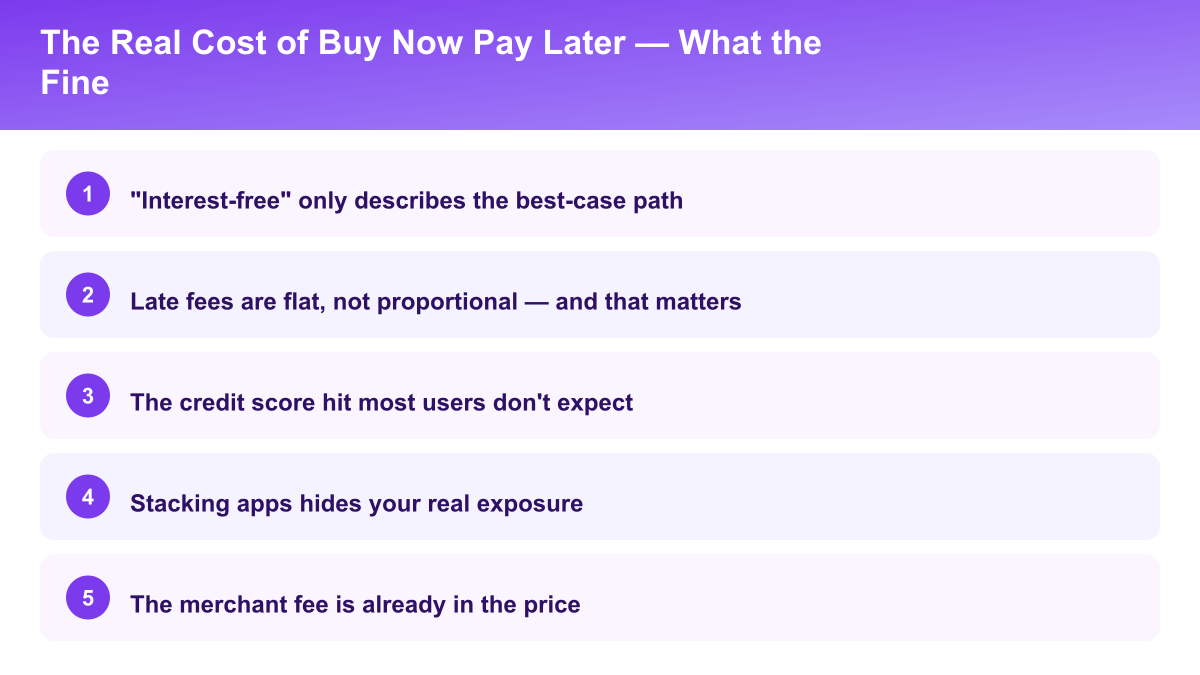
"Interest-free" only describes the best-case path
BNPL is structured as a short-term, fee-based credit line, not a loan with interest baked in from day one. As long as you repay by the due date, the lender doesn't charge interest — they make their margin from the merchant, who pays a fee to offer BNPL at checkout because it increases cart conversion. The moment you miss the due date, the pricing model flips from merchant-funded to fee-funded, and that's where BNPL stops looking like a discount and starts looking like debt.
Late fees are flat, not proportional — and that matters
Most BNPL late fees are a fixed amount rather than a percentage of what you owe. LazyPay, for instance, charges a flat penalty of around ₹15 for every day a payment stays overdue; Amazon Pay Later's late fees can run up to ₹600 depending on the amount owed. Either way, that means a missed ₹300 payment can carry a late fee that's a large percentage of the principal — nothing like a credit card's roughly 3-3.5% monthly interest calculated on the actual balance. On a small purchase, a single missed BNPL due date can cost you more, proportionally, than paying a credit card bill a month late.
The credit score hit most users don't expect
Several BNPL providers in India now report repayment behavior to credit bureaus. Under RBI's updated credit-reporting rules, effective January 1, 2025, lenders must update bureau records every 15 days and are required to warn a borrower by SMS or email before reporting a missed payment as a default — but once that warning window passes, a missed BNPL payment can show up as a default on your credit report the same way a missed credit card EMI would — even though the purchase might have been a ₹600 food order. People treat BNPL as disposable because the amounts are small; the credit bureau doesn't grade on amount.
Stacking apps hides your real exposure
Because each BNPL app runs its own limit and its own due date, someone using three or four at once has no single place that shows total outstanding credit. A ₹2,000 limit on each app feels harmless individually; ₹8,000 across four apps with four different due dates is a real liability that's easy to lose track of, since none of them show up as a single line item the way a credit card statement does.
The merchant fee is already in the price
Merchants pay the BNPL provider a fee per transaction, typically a small percentage of order value, to offer it at checkout. That fee gets folded into pricing across the board — it isn't itemized separately to you, but it's a reason "0% BNPL" isn't free money outside the transaction; it's a cost already distributed into what things cost on that platform.
How BNPL Differs From a Regular Personal Loan
A personal loan is underwritten with a full application, often a credit check, and disburses as a lump sum with a fixed EMI schedule. BNPL is approved almost instantly at checkout, with underwriting based on much thinner data. That's exactly why limits stay small initially, and why the products lean so heavily on fee structures rather than interest to make their margin on a much lower-friction approval process.
The Psychology Behind Why Small Amounts Feel Harmless
Splitting a ₹6,000 purchase into four payments of ₹1,500 changes how the purchase feels in the moment — each individual payment reads as small even though the total commitment is identical to paying the full amount upfront. This isn't accidental. Checkout flows are designed around this framing effect, and being aware of it is the simplest defense against it, since knowing a nudge exists measurably reduces how well it works on you.
How to use it without losing money
- Treat every BNPL due date with the same seriousness as a credit card due date — set a calendar reminder, don't rely on the app's push notification.
- Never run more than one BNPL provider at a time if you're prone to losing track.
- Check your credit report every few months for BNPL entries you didn't expect.
- If you can't repay within the interest-free window, a credit card's revolving interest, while not cheap, is at least calculated proportionally and disclosed on the statement, unlike a flat late fee that can dwarf a small purchase.
Used on time, BNPL costs nothing extra — that part of the pitch holds up. The thing worth managing is narrower than "debt": a flat late fee that doesn't scale down for a small purchase, and a credit bureau entry that doesn't care how small that purchase was. Track the due dates the way you'd track a credit card bill, and the zero-interest claim stays true. Check the number once before you commit, not after.
Frequently Asked Questions
Was this article helpful?
Written by
Muthu
I'm Muthu, a software engineer based in India who writes about technology, career growth, and personal finance on the side. I started Techpulzo because most content in these spaces online is either too shallow to be useful or too jargon-heavy to actually help you decide anything — so every article here starts from a real question I'd want answered myself, and tries to show the actual numbers and trade-offs instead of surface-level advice.
Comments
No comments yet. Be the first to share your thoughts!
Related Posts

Buying vs Leasing a Car in India — The Math Most People Get Wrong
Why the monthly payment is the least useful number for comparing the two
A lease payment looks cheaper than a loan EMI for a reason that has nothing to do with which one costs less. Here's the real total-cost comparison, including the fees both options hide.

Credit Score in India: How It Works and How to Fix a Bad One
What actually moves the number, and the realistic timeline for recovering from a damaged score
Your credit score comes down to two things: do you pay on time, and how much of your available credit are you using. Here's exactly how each factor is weighted, and how to recover from a bad score.

Is an MBA Worth It in India? Costs, Salaries and Payback Time
The break-even calculation that matters more than the generic yes-or-no answer
"Is an MBA worth it" is really three separate questions: is this specific college's placement data strong, does the switch require the credential, and can you afford the real cost. Here's how to run the numbers.

How Much Home Loan You Can Afford — The Math Banks Don't Show You
What a bank will approve and what actually leaves you financially comfortable are two different numbers
Banks will approve an EMI that eats half your take-home pay. That doesn't mean you should take it. Here's the real affordability math, the hidden first-year costs, and how to stress-test the decision.