
Buying vs Leasing a Car in India — The Math Most People Get Wrong
Why the monthly payment is the least useful number for comparing the two
Leasing a car purely because the monthly number looks smaller is one of the easiest ways to underestimate the real cost. Buy a ₹10 lakh car outright, loan it, or lease it, and the "cost" of that same car ends up wildly different in each case. The monthly EMI number alone hides almost all of that difference. Here's the actual math, including the parts dealerships never walk you through.
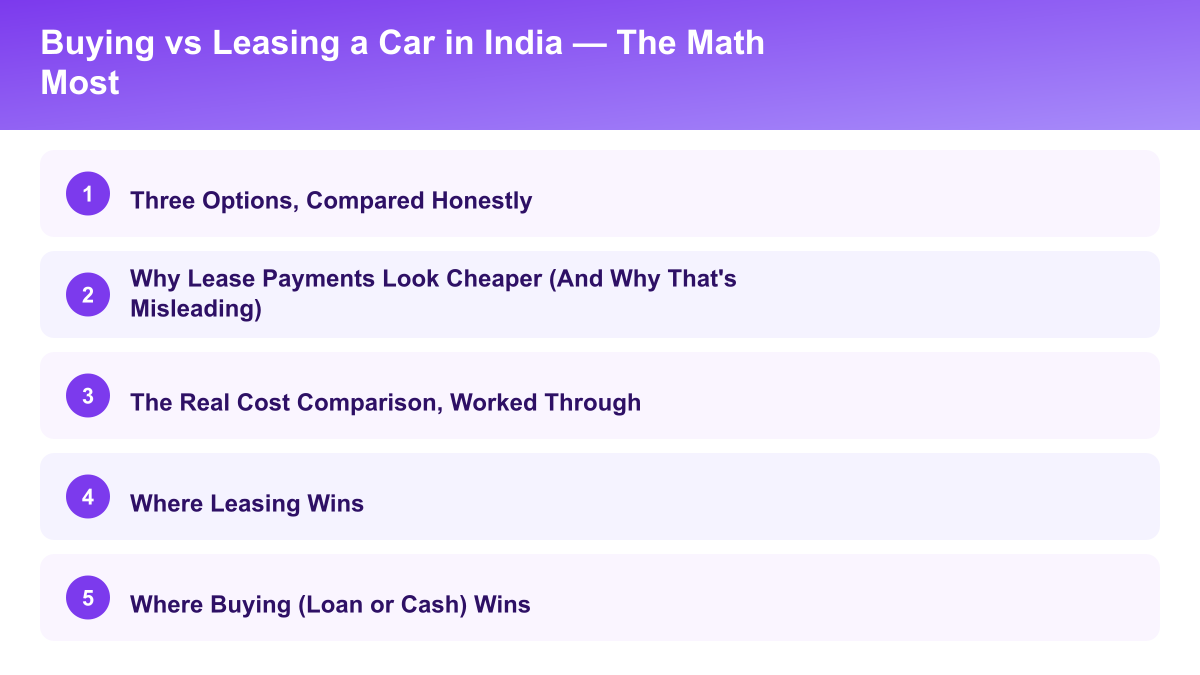
Three Options, Compared Honestly
| Outright Purchase | Car Loan | Lease | |
|---|---|---|---|
| Who owns it | You, immediately | You, once fully repaid | The leasing company, always |
| Monthly cost | None (one-time payment) | Higher, but builds ownership | Lower, but builds nothing |
| At the end | You keep an asset | You keep an asset | You return the car and start over |
| Best for | Long-term ownership, have the cash | Long-term ownership, need financing | Want a new car every 2-3 years, or a business claiming tax deductions |
Why Lease Payments Look Cheaper (And Why That's Misleading)
A lease payment is calculated on the car's depreciation over the lease term plus interest, not on the car's full value — you're paying for the portion of the car's life you're using, which is why the monthly number looks smaller. But at the end of a 3-year lease, you have exactly nothing to show for those payments — no asset, no equity, nothing to sell. A loan's EMI is higher for the same car because you're paying toward owning 100% of it, not just the depreciation slice.
The Real Cost Comparison, Worked Through
Take an illustrative ₹10 lakh car. A 5-year loan at a current representative new-car rate of roughly 8.75-9.6% (SBI: 8.75-9.25%, ICICI: 8.85-9.60%, as of August 2026), after a 20% down payment, runs an EMI around ₹16,600/month — total repayment around ₹9.96 lakh on top of the ₹2 lakh down payment, and at the end you own a car worth perhaps ₹4-5 lakh (resale value after depreciation). A comparable 3-year lease through a real personal-leasing operator like Orix India or Ayvens (formerly ALD Automotive) might run ₹18,000-22,000/month with no down payment — this monthly figure is an illustration, not a quoted rate, since these providers price leases per vehicle and tenure rather than publishing a standard rate card — total paid around ₹6.5-8 lakh over 3 years, and at the end you own nothing and need a new arrangement.
Over 5 years, the loan path leaves you with a car worth real money. The lease path, run twice to cover the same 5 years, leaves you with nothing owned and a total spend that can exceed the loan's, once you account for having to lease again after year three.
Where Leasing Wins
- You want a new car every 2-3 years — leasing is built for exactly this pattern, and fighting resale value on a loaned car every few years is its own hassle and cost
- You run a business and can claim the lease as a deductible expense — this is the strongest, most common legitimate case for leasing in India, since the tax treatment can change the real cost calculation
- You don't want to deal with resale — a lease removes the effort and uncertainty of selling a used car yourself
Where Buying (Loan or Cash) Wins
- You plan to keep the car 5+ years — ownership cost per year drops sharply the longer you keep a paid-off car, since there's no monthly payment left
- You drive a lot — leases commonly cap annual mileage (often 10,000-15,000 km/year) with real per-km penalties beyond that; high-mileage drivers get hit hard by lease terms
- You want to eventually sell or pass on an asset — a leased car is never yours to sell, gift, or leave paid off
The Costs Both Options Hide
- Insurance — often higher on a leased car since the leasing company mandates comprehensive coverage with specific terms
- Mileage penalties on a lease — commonly ₹5-10 per km over the agreed limit, which adds up fast for anyone commuting long distances
- End-of-lease wear-and-tear charges — leasing companies inspect the car at return and can charge for damage a car owner would simply absorb as part of owning something that depreciates
- Loan processing fees and mandatory insurance bundling — often pushed at the point of financing, adding to the real cost beyond the advertised EMI
The Actual Decision Framework
Ask two questions, honestly: how long do you plan to keep this car, and do you have a genuine tax reason to lease (business use) rather than a lifestyle reason (wanting something new often)? If you're keeping it 5+ years with no business tax angle, a loan or outright purchase almost always wins on total cost. If you're churning cars every 2-3 years regardless, or have a real deductible business use, leasing's convenience can be worth its higher long-run cost.
Balloon Payment Loans: A Third, Riskier Hybrid
Some financing options offer a "balloon payment" structure — lower EMIs throughout the loan term, with a large lump-sum payment due at the end to own the car outright. This can look attractive month to month, similar to a lease, but carries real risk if you don't have that lump sum ready when it comes due, forcing either an unplanned large payment, a refinance at whatever rates are available then, or returning the car, having paid years of EMIs toward an asset you still don't own.
The Depreciation Curve Most Buyers Ignore
New cars lose a disproportionate share of their value in the first year, often 15-20%, compared to subsequent years, which matters directly for the buy-versus-lease comparison. If you buy outright or on a loan and plan to sell within 2-3 years, you're absorbing the steepest part of that depreciation curve yourself; a lease effectively shifts that steepest depreciation cost onto the leasing company, priced into your monthly payment. This is part of why leasing can make more sense for someone who churns cars every 2-3 years, even setting aside the tax angle.
Is a Used Car Loan a Different Calculation Entirely
Yes, in a meaningful way. Used car loan rates in India typically run 1.5-3 percentage points higher than new car loans at the same bank (SBI, for example, prices used-car loans at 10.25-11.50% against 8.75-9.25% for new cars as of August 2026), but you skip the steepest first-year depreciation entirely, since someone else already absorbed it. For pure cost per year of ownership, a well-chosen used car often beats both buying and leasing new. And a larger down payment isn't automatically the smarter move. It reduces total interest paid, sure, but only if that money wasn't better used somewhere else, clearing higher-interest debt, say, or sitting in an emergency fund. Compare the loan's interest rate against what that money would otherwise cost or earn you before assuming putting more down is always right.
Compare Totals, Not Monthlies
That's the trap the monthly number sets, and it's an easy one to fall into. The monthly payment is the least useful number for comparing buying versus leasing; it's designed to look attractive on both sides, for different reasons. Compare total cost over the period you'll use the car, and factor in what you own, or don't, at the end, before the EMI number makes the decision for you.
Frequently Asked Questions
Was this article helpful?
Written by
Muthu
I'm Muthu, a software engineer based in India who writes about technology, career growth, and personal finance on the side. I started Techpulzo because most content in these spaces online is either too shallow to be useful or too jargon-heavy to actually help you decide anything — so every article here starts from a real question I'd want answered myself, and tries to show the actual numbers and trade-offs instead of surface-level advice.
Comments
No comments yet. Be the first to share your thoughts!
Related Posts

Credit Score in India: How It Works and How to Fix a Bad One
What actually moves the number, and the realistic timeline for recovering from a damaged score
Your credit score comes down to two things: do you pay on time, and how much of your available credit are you using. Here's exactly how each factor is weighted, and how to recover from a bad score.

How Much Home Loan You Can Afford — The Math Banks Don't Show You
What a bank will approve and what actually leaves you financially comfortable are two different numbers
Banks will approve an EMI that eats half your take-home pay. That doesn't mean you should take it. Here's the real affordability math, the hidden first-year costs, and how to stress-test the decision.
Zero-Based Budgeting: A Practical Guide to Giving Every Rupee a Job
The budgeting method that forces you to plan discretionary spending before you make it
Zero-based budgeting assigns every rupee of income a job before the month starts. A step-by-step method for setting one up, with a worked example.

Best Time of Year to Buy Electronics in India: What the Sales Calendar Shows
The deepest discounts cluster around a few predictable windows, and buying right before a launch event usually costs you money
Indian electronics prices follow a predictable annual pattern around a handful of sale events. Here is how to time a purchase around it.