
Credit Score in India: How It Works and How to Fix a Bad One
What actually moves the number, and the realistic timeline for recovering from a damaged score
Fifty to seventy points — that's roughly what a credit card bill can cost you once it's actually reported as a missed payment, and the damage sits on your report for years afterward. That reporting threshold matters: most issuers don't flag a payment as missed to the bureau until it's around 30 days past due, not a few days late, so a bill paid five days after the due date typically means a late fee, not a bureau-reported miss. Most people only start paying attention to their credit score the moment they need a loan, which is precisely the moment it's too late to fix a bad one quickly. Here's how the number works and what moves it.
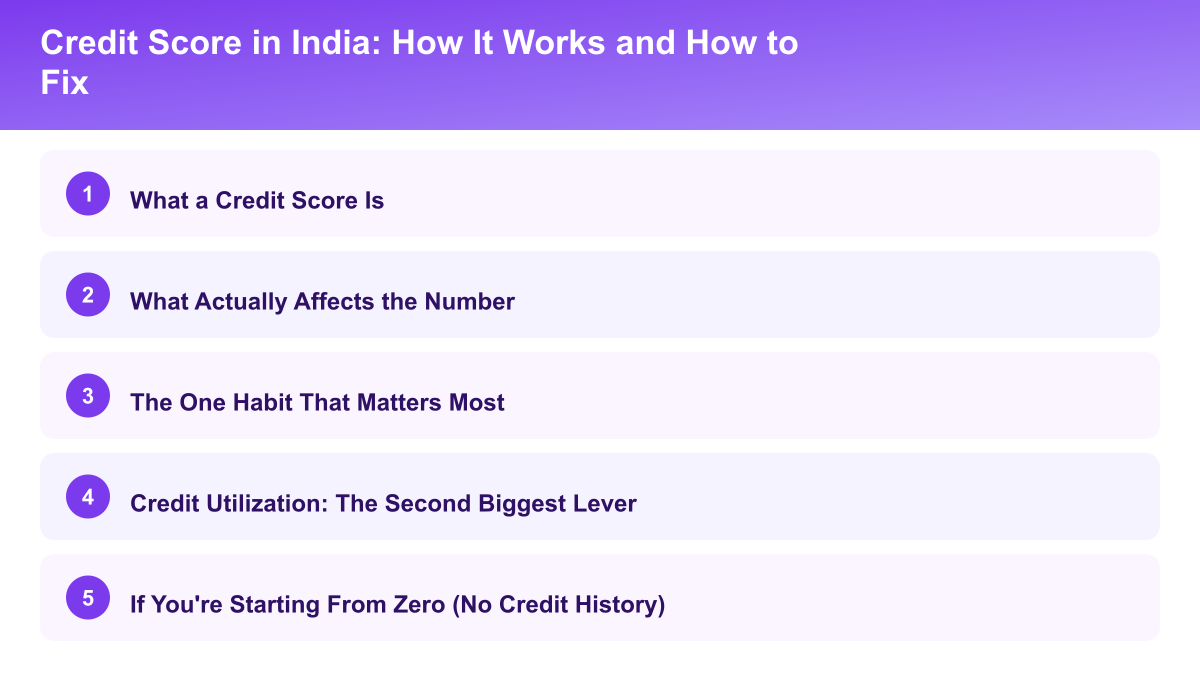
What a Credit Score Is
In India, your credit score (most commonly your CIBIL score, ranging 300-900) is a single number summarizing how reliably you've repaid borrowed money in the past — credit cards, loans, EMIs. Lenders use it to decide whether to approve you and what interest rate to offer. Above 750 is generally considered good and unlocks better rates; below 650 makes approval harder and, when you are approved, more expensive.
What Actually Affects the Number
TransUnion CIBIL does not publish exact percentage weights for each factor the way some other scoring models do — there is no official "35% payment history, 30% utilization" breakdown from CIBIL itself. What CIBIL does publish, in its own consumer-education material, is the list of factors that make up the score, listed here in the order CIBIL presents them, with no percentage attached to any of them:
| Factor | What It Means |
|---|---|
| Payment history | Whether you've paid bills and EMIs on time — CIBIL describes late payments and defaults as having the biggest negative impact of any factor |
| Credit utilization | How much of your available credit limit you're using; CIBIL flags high utilization as a sign of rising debt burden |
| Length of credit history | How long you've been managing credit accounts |
| Credit mix | Whether you have a balanced mix of secured credit (like a car or home loan) and unsecured credit (like credit cards) |
| New credit / inquiries | How often you've applied for new credit recently — several applications in a short window reads as rising risk to lenders |
Source: TransUnion CIBIL's own consumer-education pages (cibil.com/blog/what-is-cibil-score and cibil.com/blog/all-you-need-to-know-about-cibil-score). If you see a specific percentage breakdown attributed to CIBIL elsewhere, treat it with some skepticism — that level of published precision comes from FICO for the US market, not from CIBIL for India.
The One Habit That Matters Most
Pay every bill, on every card and loan, on or before the due date — not the statement date, the due date. A single missed payment does more damage than almost anything else on this list, and it stays on your credit report for years even after you pay it off. If you only fix one thing, set up autopay for at least the minimum amount due on every card, so a missed payment becomes structurally difficult rather than something you have to remember.
Credit Utilization: The Second Biggest Lever
Keep the amount you owe below 30% of your total available credit limit at any given time — below 10% is even better if you're actively trying to raise your score before a big loan application. This means: a ₹1,00,000 total credit limit across your cards should ideally show under ₹30,000 owed at any point lenders check.
- Pay down balances before the statement date, not just before the due date — utilization is often calculated on the statement date, not when you pay
- Ask for a credit limit increase on an existing card (this lowers your utilization percentage on the same spending) — but only if you're confident it won't tempt you to spend more
- Spread spending across multiple cards rather than maxing out one, if you have more than one
If You're Starting From Zero (No Credit History)
- Get a secured credit card against a fixed deposit — banks approve these easily since the FD backs the risk
- Use it for small, regular purchases you'd make anyway (groceries, fuel) — not to spend more than you would with cash
- Pay the full statement balance every month, not just the minimum due
- Give it 6-12 months of consistent on-time payment before applying for a bigger unsecured card or loan
If Your Score Is Already Damaged
- Check your report first — pull your free credit report (CIBIL, Experian, or Equifax all offer at least one free check per year) and look for errors; incorrectly reported late payments or accounts that aren't yours are more common than people expect, and disputing them can recover points fast
- Clear any overdue amounts immediately — an account currently in default drags the score down every month it stays unpaid, not just once
- Don't close old cards — closing your oldest card shortens your credit history length and can lower your score, even if you've stopped using it
- Avoid applying for new credit while rebuilding — each hard inquiry dings the score slightly, and several in a short window looks like financial distress to lenders
How to Actually Check Your Score, Free
The Reserve Bank of India requires each of the four credit bureaus operating in India — TransUnion CIBIL, Experian, Equifax, and CRIF High Mark — to give you one free full credit report a year if you request it directly from them, not through a comparison site. For CIBIL specifically, that's the "Free CIBIL Score and Report" option at cibil.com; Experian India runs its consumer free-report access through consumer.experian.in; Equifax India's is at equifax.co.in. Each asks for broadly the same identity details — PAN, full name as it appears on your PAN, date of birth, and a mobile number or email for OTP verification — since PAN is the primary identifier bureaus use to match your file. Equifax's online flow additionally asks for an address and a KYC document (PAN, Aadhaar, passport, voter ID, or driving licence); if you can't complete it online, Equifax also accepts a paper request with ID and address proof, delivered within about a week.
Separately, plenty of banking and fintech apps offer a free CIBIL or Experian score check as a standing, refreshed-monthly feature — this works because those apps have a commercial arrangement to pull scores in bulk. You're not paying, but you are granting the app permission to fetch your credit data, which sometimes comes bundled with loan or card marketing. If you'd rather skip that, go directly to the bureau's own site instead.
Because each bureau keeps separate records and its own proprietary model, don't be surprised if the number differs by ten to thirty points between them — lenders don't all report to every bureau at the same frequency. Checking more than one occasionally, particularly before a major loan application, gives a fuller picture than relying on a single number.
How Long Recovery Actually Takes
A single late payment, if it's an isolated incident and everything else stays clean, typically recovers within 3-6 months of consistent on-time payments afterward. A pattern of missed payments or a defaulted loan takes considerably longer — often 12-24 months of clean history to rebuild, since lenders and scoring models weight recent behavior more heavily than old history, but a serious default can remain visible on your report for years.
How Loan Guarantors and Joint Accounts Affect Your Score
Being a guarantor or co-applicant on someone else's loan makes that loan's payment history part of your own credit report too — if the primary borrower misses payments, your score takes the hit exactly as if it were your own missed payment, regardless of whether you personally handled any of the money. This is worth weighing before agreeing to guarantee a loan for family or friends, since the credit consequence is real and not merely nominal.
Why Checking Your Own Score Doesn't Hurt It
A common misconception is that checking your own credit score damages it — this only applies to "hard inquiries," which happen when a lender checks your score as part of a loan or credit card application. Checking your own score through a credit bureau's official free-check service or most banking apps is a "soft inquiry" and has no effect on the score at all, so there's no reason to avoid monitoring it regularly.
Two Things People Usually Get Wrong
Multiple credit cards don't hurt your score just by existing. If you're paying every one of them on time, having more cards can help, since it raises your total available credit and lowers your utilization percentage on the same spending. The only catch is opening several new ones in a short window, which does ding the score temporarily. And your salary has nothing to do with it directly. Indian credit scores are built entirely from borrowing and repayment behavior, not income. A lender looks at income separately when deciding how much to lend you, but the score itself doesn't know or care what you earn.
Two Habits, Not Tricks
Strip away the mystery and a credit score is a direct reflection of two things: whether you pay on time, and how much of your available credit you're using. Fix those two consistently and the score follows on its own. No credit repair service or clever trick beats simply automating on-time payments and keeping utilization low for a few consistent months.
Frequently Asked Questions
Was this article helpful?
Written by
Muthu
I'm Muthu, a software engineer based in India who writes about technology, career growth, and personal finance on the side. I started Techpulzo because most content in these spaces online is either too shallow to be useful or too jargon-heavy to actually help you decide anything — so every article here starts from a real question I'd want answered myself, and tries to show the actual numbers and trade-offs instead of surface-level advice.
Comments
No comments yet. Be the first to share your thoughts!
Related Posts

Buying vs Leasing a Car in India — The Math Most People Get Wrong
Why the monthly payment is the least useful number for comparing the two
A lease payment looks cheaper than a loan EMI for a reason that has nothing to do with which one costs less. Here's the real total-cost comparison, including the fees both options hide.

How Much Home Loan You Can Afford — The Math Banks Don't Show You
What a bank will approve and what actually leaves you financially comfortable are two different numbers
Banks will approve an EMI that eats half your take-home pay. That doesn't mean you should take it. Here's the real affordability math, the hidden first-year costs, and how to stress-test the decision.
Zero-Based Budgeting: A Practical Guide to Giving Every Rupee a Job
The budgeting method that forces you to plan discretionary spending before you make it
Zero-based budgeting assigns every rupee of income a job before the month starts. A step-by-step method for setting one up, with a worked example.

Best Time of Year to Buy Electronics in India: What the Sales Calendar Shows
The deepest discounts cluster around a few predictable windows, and buying right before a launch event usually costs you money
Indian electronics prices follow a predictable annual pattern around a handful of sale events. Here is how to time a purchase around it.