
Why "Just Learn to Code" Doesn't Get Freshers Hired in 2026
The bar moved when AI assistants started handling the work that used to prove basic competence
"Just learn to code and you'll get a job" was reasonable advice a decade ago. It's no longer reliable advice on its own, and the reason isn't opinion — it's visible in the hiring numbers. Fresh graduate hiring at India's IT services firms fell from a peak of roughly 600,000 in FY2022 to around 120,000 in FY2025, an 80% drop over three years, according to Livemint reporting on the sector. Entry-level tech job postings fell a further 44% year-over-year as of mid-2026, per staffing firm Xpheno, hitting their lowest level in 28 months. That's not a hiring freeze; it's a structural shift in what "entry-level" even means now, and most "just learn to code" advice online hasn't caught up to it.
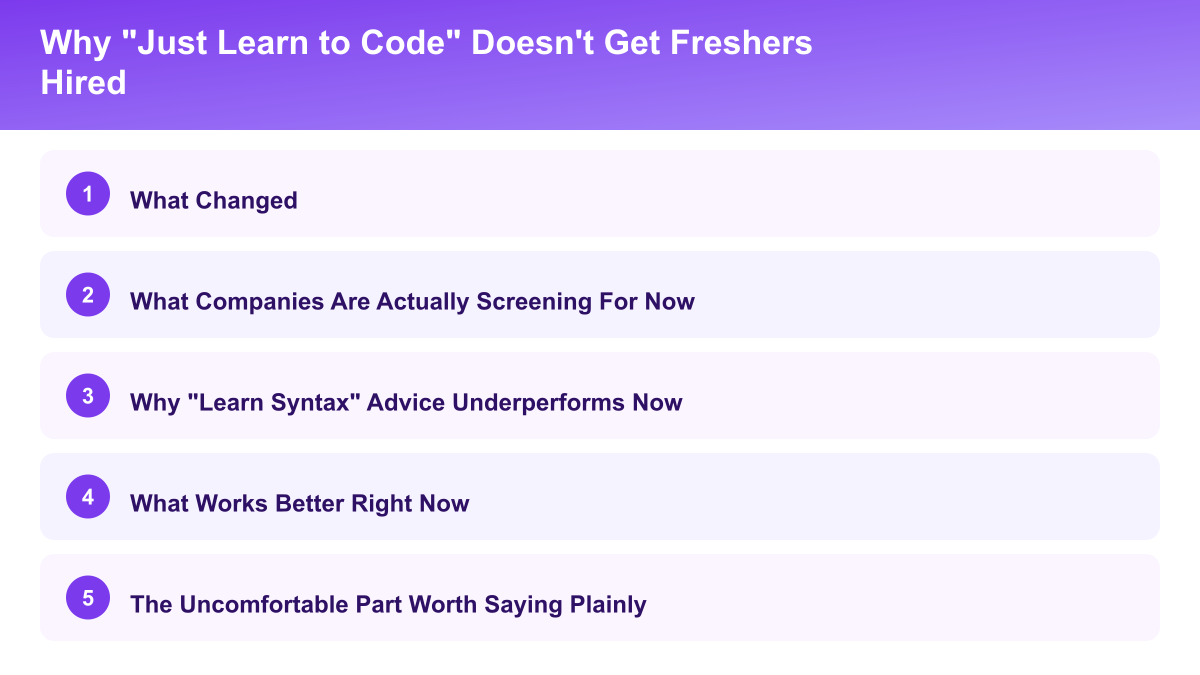
What the hiring data shows
A 2025 EY analysis, cited widely in Indian business press, estimates entry-level IT roles have already declined 20-25% due to automation — with AI tools now capable of handling an estimated 20-40% of common tech functions like coding, generating test cases, and maintaining documentation. That's exactly the work a fresher's first two years used to consist of. The company-level numbers back this up: Wipro cut its fresher hiring target to 7,500-8,000 from 10,000, TCS's headcount fell by 23,460 in FY2026 alongside a 12,000-person layoff, and Infosys's under-30 workforce share dropped to 50.7%, the lowest in 15 years. None of this means junior roles have vanished. It means the volume of roles that existed purely to have someone write routine boilerplate has shrunk, because that specific work is what AI assistants now do fastest and cheapest.
What Companies Are Screening For Now
- Judgment over output — can you explain why a particular approach is better than three alternatives, not just that it works
- Debugging unfamiliar code — increasingly tested directly, since reading and fixing code (including AI-generated code) is now a bigger share of real junior work than writing from scratch
- System-level thinking, even at junior level — how a piece fits into a larger application, not just whether the function itself is correct
- AI fluency specifically — NASSCOM's 2026 AI-Native Talent Index puts over 90% of India's early-career tech workforce at AI-native or AI-proficient already, which raises the baseline: not using AI tools at all is now itself a gap, not a point of pride
Why "Learn Syntax" Advice Underperforms Now
Syntax fluency used to be a real bottleneck — the thing that separated someone who could build software from someone who couldn't. AI assistants have compressed that bottleneck dramatically; syntax recall is now one of the least scarce skills in the room. Advice built entirely around "learn the language, build the standard projects" optimizes for a bottleneck that's mostly gone, while the current bottleneck — judgment, debugging, and explaining your reasoning under questioning — gets little to no deliberate practice from that path.
What Works Better Right Now
- Build fewer, more original projects — one project solving a specific, slightly unusual problem beats three tutorial clones; interviewers can tell the difference within two follow-up questions
- Practice explaining your code out loud, including AI-assisted code — if you used an AI assistant to help write part of a project, be able to explain every line as if you wrote it yourself, because that's exactly what gets asked
- Deliberately practice reading and fixing broken code, not just writing new code — pick a moderately complex open-source project, introduce a bug into a local copy, then find and fix it using only reading and reasoning. This is a more accurate rehearsal of both real junior work and how technical interviews are now structured than another tutorial-following project would be
- Learn to reason about trade-offs, not just implementations — "why this approach and not that one" is a question that shows up constantly now, and it's not something memorizing syntax prepares you for
Disclosing AI Tool Use Without Undermining Yourself
Being asked "did you use AI for this" is increasingly common, and the strong answer is neither denial nor over-apologizing — it's demonstrating that you directed the tool and can defend every resulting decision. "I used it to scaffold the initial structure, then rewrote the authentication logic myself after finding a security issue in what it generated" signals judgment; a vague "yes, AI helped" with no specifics signals the opposite. Refusing to use tools that are now standard in professional environments doesn't show a stronger skill either — it just shows unfamiliarity with how the job gets done today.
What This Doesn't Mean
It doesn't mean coding skills are worthless, and it doesn't mean bootcamps or self-taught paths are dead ends — plenty of freshers are still getting hired through exactly those paths. It means the specific proof-of-competence that used to work on its own (a working app, fluent syntax) needs to be paired with visible judgment and reasoning, demonstrated actively, rather than assumed to follow automatically from being able to build something that runs. "Learn to code" was never wrong; it's just incomplete for a hiring market where the routine half of that work is no longer what gets you through the door.
Frequently Asked Questions
Was this article helpful?
Written by
Muthu
I'm Muthu, a software engineer based in India who writes about technology, career growth, and personal finance on the side. I started Techpulzo because most content in these spaces online is either too shallow to be useful or too jargon-heavy to actually help you decide anything — so every article here starts from a real question I'd want answered myself, and tries to show the actual numbers and trade-offs instead of surface-level advice.
Comments
No comments yet. Be the first to share your thoughts!
